Tables, sets, heaps, and queues
Tables
Table/new creates a mutable hash table. Its public operations place the
table last, including mutating operations:
(let scores (Table/new))
(Table/set! "Ada" 10 scores)
(Table/set! "Lin" 20 scores)

(Table/has? "Ada" scores)
(Table/get "Ada" scores)
Table/get returns the table’s entry-vector form. Table/get* returns an
(Option V) for a checked lookup; use Table/get-unsafe when presence is
already established:
(match (Table/get* "Ada" scores)
  None 0
  (Some score) score)

(if (Table/has? "Ada" scores)
    (Table/get-unsafe "Ada" scores)
    0)
Table/update! and Table/update-or! cover common count/accumulator patterns;
Table/entries, Table/keys, Table/values, and Table/count expose its
contents. Tables support their established key representations, including
strings and closed enum tags. Use Table/new/capacity when an approximate
entry count is known, and Table/compact! to rebuild after substantial
deletion.
Sets
Set/new, Set/add!, Set/remove!, Set/has?, Set/values, and set algebra
are provided for the library’s set representation. As with tables, query the
specific function type for the accepted key kind:
que --lib types 'Set/*'
Set algebra
Set/intersection, Set/union, Set/difference, and Set/xor each create a
new set; neither input set is changed. Let A = {"red", "blue", "green"}
and B = {"green", "gold"}:
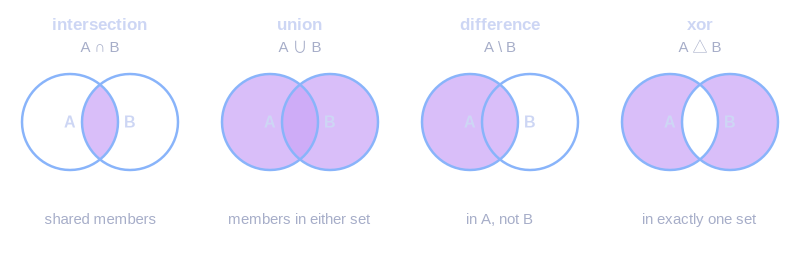
| Operation | Mathematical meaning | With A and B |
|---|---|---|
(Set/intersection A B) | values in both sets, A ∩ B | {"green"} |
(Set/union A B) | values in either set, A ∪ B | {"red", "blue", "green", "gold"} |
(Set/difference A B) | values in the first but not the second, A \ B | {"red", "blue"} |
(Set/xor A B) | values in exactly one input, (A \ B) ∪ (B \ A) | {"red", "blue", "gold"} |
(let A (Vector->Set ["red" "blue" "green"]))
(let B (Vector->Set ["green" "gold"]))

(let common (Set/intersection A B))
(let all (Set/union A B))
(let only-A (Set/difference A B))
(let exclusive (Set/xor A B))

{ (Set/has? "green" common)    ; true
  (Set/has? "red" common)      ; false
  (Set/has? "gold" all)        ; true
  (Set/has? "blue" only-A)     ; true
  (Set/has? "green" exclusive)} ; false
Set/difference is directional: swapping its arguments changes the result.
Set/xor is symmetric, so (Set/xor A B) and (Set/xor B A) contain the
same members. A set’s bucket layout does not promise a presentation order; if
you need a deterministic displayed vector, convert with Set->Vector and sort
the result.
Heap and deque
Heap/* implements a mutable binary heap using a caller-supplied comparison
predicate. Que/* provides a deque-like structure backed by vectors, with
operations such as Que/push!, Que/prepend!, Que/first, Que/last, and
Que/deque!.
These structures favor explicit mutation and predictable representation over hidden GC behavior. Use the public namespace functions rather than relying on their internal vector layout.
Matrices
Matrix/new, Matrix/in-bounds?, Matrix/for/i, and related helpers cover
nested-vector matrix work. Matrix coordinates are explicit Int values; use
the bounds helper before dynamic access when static analysis cannot prove an
index safe.