WebAssembly target
Calque lowers its typed AST into WebAssembly. Core scalar values fit the Wasm
i32 model: Int, Bool, Char, zero-payload enum tags, Dec, and unit all have compact
scalar lowering. Managed collections and closures use the runtime’s reference
counted representation.
Wasm32 today
The default target is Wasm32: linear-memory addresses and array indexes in the
runtime are i32. An Int index is signed at the language level, while Wasm
memory addressing is unsigned internally; valid program indices are therefore
non-negative and bounded by the allocated vector length.
Wasm32’s address space is bounded by its configured linear memory limits. This
does not make the language architecture obsolete: Wasm continues to support
i32 operations on 64-bit hosts, and memory64 can be introduced later with an
explicit wider language type rather than changing existing Int behavior.
Inspect generated output
que program.que --emit source --out expanded.que
que program.que --opt --emit opt-source --out optimized.que
que program.que --opt --emit wat --out program.wat
que program.que --opt --emit wasm --out program.wasm
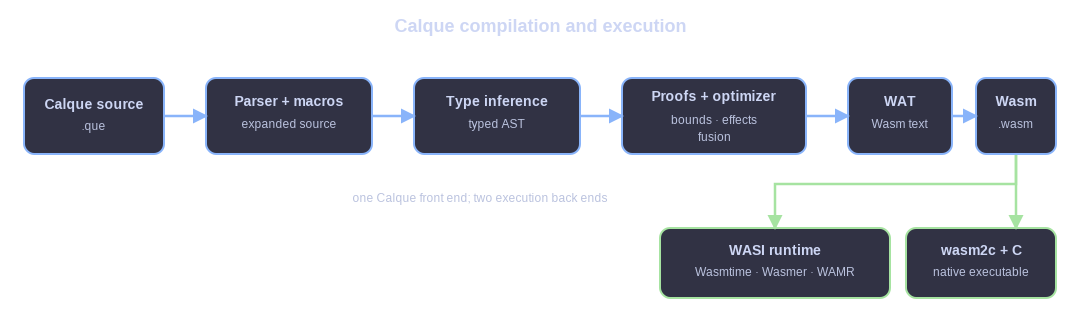
Use this when optimizing or reporting a compiler bug. The expanded source shows macro lowering; optimized source shows source-level rewrites; WAT shows the final Wasm structure.
Runtime choices
que program.que compiles then invokes an external WASI runtime. Wasmtime is
the default runtime; Wasmer and iwasm/WAMR can also be selected.
The repository’s native path runs generated Wasm through wasm2c and a C
compiler. It is deliberately separate from the main que command:
./scripts/compile-native-c.sh program.que
This is useful for completed compute-heavy programs and native benchmarking. It is not a different source language: static typing, macro expansion, and Wasm generation occur first in the same compiler.
serialize and deserialize also stay in the generated guest Wasm on this
path. Their record and payload-enum format is therefore the same under
Wasmtime and under wasm2c/native C. The native wrapper uses that codec for a
program’s final result too, including direct record and payload-enum returns.
For the debug/optimized safety boundary and a release checklist, see Debug, optimized, and native execution.